
Title 19 Comprehensive Zoning Update

Salt Lake County is updating its zoning ordinance, Title 19 of the County Code, to meet the County's goal to create safe and beautiful places for current and future generations to live, work, and recreate. The updated zoning code will provide greater clarity on policies and processes to reduce confusion and support property owners wishing to know what they can do with their property.

Title 19 has not undergone a comprehensive update in over 30 years. Salt Lake County is much different than it was 30 years ago, and it is important that the zoning code reflects current community needs. This is a big undertaking, and the County has broken this effort up into five phases.

Meeting Information

Phase 1: August 2026

Salt Lake County Planning Commission: 8/12/26 at 8:30 AM

Mountainous Planning District Planning Commission: 8/20/26 at 3:00 PM

Agenda and Information Packet Forthcoming

Phase 2: September 2026

Salt Lake County Planning Commission: 9/9/26 at 8:30 AM

Mountainous Planning District Planning Commission: 9/17/26 at 3:00 PM

Agenda and Information Packet Forthcoming

Phase 3: October 2026

Salt Lake County Planning Commission: 10/14/26 at 8:30 AM

Mountainous Planning District Planning Commission: 10/15/26 at 3:00 PM

Agenda and Information Packet Forthcoming

Phase 4: November 2026

Community Workshop: November 4, 2026

Location: Midvale Library

Time: 6 PM

Agenda and Information Packet Forthcoming

Phase 5: November-February

Mountainous Planning District Planning Commission Public Hearing and Recommendation: November 19, 2026

Salt Lake County Planning Commission Public Hearing and Recommendation: December 9, 2026

Salt Lake County Council Public Hearing and First Reading: February 2027

Agenda and Information Packet Forthcoming

Frequently Asked Questions

The Basics

Title 19 of the Salt Lake County Code is the county's zoning ordinance, which balances property rights with the general health, safety, and welfare of the community.

 The zoning ordinance (also known as the zoning code) determines the use and development of property in the unincorporated county.

Zoning regulations dictate what types of uses or activities may be conducted on your property, as well as the size, height, siting, and appearance of buildings and structures.

The Title 19 project is described as a comprehensive update involving a full repeal and rewrite of the zoning code. Does that mean my property is being rezoned?

No. Salt Lake County is proposing to amend the text of the zoning ordinance only; the zoning designation will not change for any property within the unincorporated county.

 In other words, the zoning district that applies to every property will remain the same, but some of the regulations that determine uses, building form, required parking and open space, etc., may change.

An overhaul of the zoning code is long overdue.

Very few changes have been made to Title 19 since the County changed its form of government at the turn of the century. Meanwhile, Salt Lake County is very different now than it was at that time.

This rewrite addresses problems that have arisen over many years with the current zoning code, incorporates modern principles and best practices in land use planning, and integrates principles and policies from the County's general plans and Moderate Income Housing Plan.

The Title 19 update only affects land in unincorporated Salt Lake County. Properties located within the boundaries of one of the 23 municipalities in Salt Lake County will continue to be governed by the zoning codes of those municipalities.

The Changes

In general, the proposed changes consolidate the code to make it more straightforward and streamlined, including merging zones where applicable, clarifying definitions, and clarifying or simplifying many development standards and other zoning provisions. 

Some additional changes include:

  1. Some obsolete zones that are no longer in use are proposed to be removed, including the Forestry Zone (F-1), one of the existing Medium Density Residential Zones (R-2-10), the Office Research Park Zone (ORD), the Mobile Home Park Zone (RMH), the Residential Compatibility Overlay Zone. 
  2. In the existing zoning code, many zones comprise their own separate chapter of the zoning ordinance, while in the proposed new code, some of the individual zones were consolidated with other zones of the same category (e.g., Manufacturing, Commercial) into the same chapter. These changes improve the clarity and navigability of the zoning ordinance. 
  3. Two new zones are proposed that would allow and encourage mixed-use development, i.e., the mixing of residential, commercial, and civic uses. The draft new zones are called the Neighborhood Mixed Use (NMU) Zone, which is intended to accommodate smaller, neighborhood-scale development; and the Corridor Mixed Use (CMU) Zone, which would be applied to significant transportation corridors and would allow for a greater intensity of mixed use development to support housing and commercial needs where they can be supported by existing infrastructure (roads, water and sewer lines, electrical lines, stormwater drainage, etc.).
  4. Many other substantive changes are proposed to specific provisions of the zoning ordinance. These include things such as conversion of many conditional uses to permitted uses with standards to mitigate impacts, building height and setback requirements, off-street parking requirements, open space and landscaping requirements, and much more.

The details of these proposed changes will be presented and discussed at the planning commission work sessions.

Most of the zones that exist in the current zoning ordinance are being retained, and the general purpose and applicability of these zones will remain the same. As noted above, some of the specific standards that apply to new or expanded buildings, changes of land use, etc., may change - but the underlying substantive content of most zoning districts will not change significantly in most cases.


No substantive changes are being proposed to the Foothills and Canyons Overlay Zone (FCOZ). This is an overlay zone that applies to environmentally sensitive mountainous, foothill, and canyon areas within unincorporated Salt Lake County, in addition to the primary or "base" zones.

The draft code will be available at the top of this page. You can also access it below.

Salt Lake County staff are available to answer specific questions about the Title 19 update and changes to specific provisions of the zoning code. You may send your questions to zoningupdate@saltlakecounty.gov. 

Contact Title 19 Zoning Ordinance Update Email

Contact the Salt Lake County Planning & Transportation team handling this ordinance update
The Process

Because this revision includes a complete reorganization of Title 19, which is a lengthy and complex set of zoning regulations, staff has broken the ordinance update project down into three phases.

Each phase will focus on a smaller set of chapters and topics within the draft new zoning code.

Phase 1:

  • Chapter 19.04 Definitions
  • Chapter 19.22: Parks and Open Space Zones
  • Chapter 19.23: Mountain Resort Zone
  • Chapter 19.24: Forestry Zones
  • Chapter 19.26: Agricultural And Foothill Agricultural Zones
  • Chapter 19.28: Single-Family Residential Zones
  • Chapter 19.30: Medium And High-Density Residential Zones
  • Chapter 19.32: Commercial Zones
  • Chapter 19.34: Manufacturing Zones
  • Chapter 19.35: S-1-G Zone
  • Chapter 19.36: Mixed Use Zones

Phase 2:

  • Article IV. Specific and Temporary Use Standards
  • Chapter 19.42: Specific Use Standards
  • Chapter 19.44: Temporary Use Standards
  • Article V. Development Standards
  • Chapter 19.46: Site Development Standards
  • Chapter 19.48: Off-Street Parking and Mobility
  • Chapter 19.50: Landscaping & Screening
  • Chapter 19.52: Signs
  • Chapter 19.54: Flood Hazard Regulations
  • Chapter 19.56: Flood Damage Prevention
  • Chapter 19.58: Geologic Hazards
  • Chapter 19.60: Airport Overlay Zone
  • Chapter 19.62: Foothills and Canyons Overlay Zone
  • Chapter 19.64: Historic Preservation
  • Chapter 19.69: Pc Zones

Phase 3:

  • Article I. General Provisions
  • Chapter 19.02: Title, Purpose And Applicability
  • Chapter 19.06: Nonconformities
  • Chapter 19.08: Enforcement
  • Chapter 19.10: Procedures For Analyzing Takings
  • Article II. Administration
  • Chapter 19.12: Administrative Bodies, Powers & Duties
  • Chapter 19.14: Zones, Zoning Map, Boundaries
  • Chapter 19.16: Land Use Processes And Procedures
  • Chapter 19.18: Planned Unit Developments
  • Chapter 19.20: Variances, Exceptions, And Appeals

The work sessions are meetings of the Planning Commissions, open to the general public, at which the commissioners will receive a presentation from staff, discuss policy and administrative questions about the sections of the zoning code being reviewed, and provide feedback and direction to staff on suggested changes to the draft. No formal action or decisions will be taken at these meetings.

The Open House is an opportunity for members of the public to learn more about the Title 19 update and to ask questions about the proposed changes to the zoning code. While this meeting will allow participants to learn about and provide input on the proposed changes to Title 19, no formal action on the zoning code changes will take place.

The public hearings are formal, publicly noticed meetings of the Salt Lake County Planning Commission, Mountainous Planning District Planning Commission, and County Council. Formal public comment will be taken at the public hearings. In addition, both planning commissions and the County Council will take formal action on the Title 19 update during the public hearings (in the case of the planning commissions, voting on a recommendation to the Council; in the case of the County Council, voting on whether to adopt the proposed updates to Title 19). The public hearings will take place after the work sessions and open house.

Yes, the work sessions and public hearings will be recorded. Links to the recordings can be found on the Utah Public Notice website under the respective planning commissions for Salt Lake County. 

There will also be links to these meetings on this Title 19 Update web page.

If you have already filed a permit, your application will be reviewed using the current code. The updated code will only apply to applications filed after the new code is formally adopted by the County Council (anticipated to be sometime in early 2027).

Who Decides

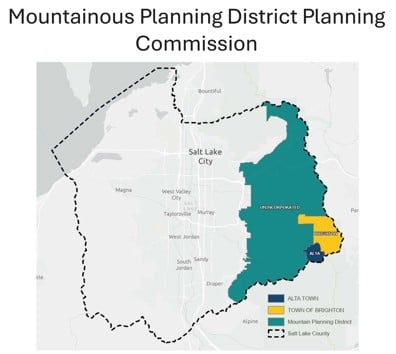
The Mountainous Planning District Planning Commission was created to manage the uniquely sensitive unincorporated lands in the Wasatch Canyons. This Planning Commission oversees land use decisions in the Mountainous Planning District, a map of which can be found here.

The Salt Lake County Planning Commission oversees land use decisions for all of the unincorporated County that falls outside of the Mountainous Planning District.


While these two planning commissions are distinct, the zoning code applies to all of unincorporated Salt Lake County, so both commissions play an important role

Mountainous Planning District Planning Commission Map.

The role of the planning commissions is to make recommendations on ordinance changes to the County's legislative body, i.e., the County Council.

The County Council has the authority to adopt new ordinances and to amend existing ordinances. Therefore, it is the County Council that will ultimately vote on the approval of the Title 19 update.

Public Input

You may submit comments to the Salt Lake County Planning Commission and/or Mountainous Planning District Planning Commission in writing at any time during the planning commission process. Send your comments via email to Wendy Gurr: wgurr@msd.utah.gov.

You may also submit comments to your elected County Councilmember directly during the County Council consideration process. You can determine who your elected councilmember is and how to contact them at the link below: https://www.saltlakecounty.gov/council/

Salt Lake County staff will be accepting written public comments at the Open House event on November 5th (at Ruth Vine Tyler County Library in Midvale, 6:30 pm), which will be considered by staff and referenced in staff reports to the planning commissions and County Council.

You may give public comment at the public hearings (remotely online or in-person), which are anticipated to take place on the following dates:

  • Mountainous Planning District Planning Commission: November 19, 2026 (tentative date)
  • Salt Lake County Planning Commission: December 16, 2026 (tentative date)
  • Salt Lake County Council: TBD; anticipated early 2027

Meeting information, including in-person locations and links to participate in meetings online, can be found on the Utah Public Notice webpages linked below. 

As with any local government legislative decision, public input is an important part of the zoning update process! All public comments will be reviewed and considered by County staff.

Public input can provide additional perspectives, insights, and information regarding the zoning regulations and how they will be applied and interpreted. When appropriate, staff may consider specific revisions to the draft zoning code in response to public comments.

You can subscribe to receive project updates on the Utah Public Notice websites linked on this Title 19 Update webpage.