When I think about what Canyons Management means for Salt Lake County, one of the first words that comes to mind is partnerships.
Our work often means teaming up with outside agencies, other County departments, and community organizations. Some people might call that complicated. We see it as a way to get far more done than any one of us could alone.
Prioritizing partnerships can mean a few more meetings and emails. But it also means we create situations in which separate agencies each bring their resources and knowledge to the same table.
For example, we create situations where perhaps one partner brings funding, another brings equipment or crews, another brings specialized expertise, and we all bring our shared desire to steward the Canyons for generations to come. The workload gets shared, and big problems get tackled by a room full of people who each know a piece of the answer.
What does partnership look like in the canyons?
The Central Wasatch and Oquirrh Mountains are managed by many different groups, including federal land managers, unincorporated County land, incorporated cities, and private property owners and businesses. No single agency covers it all, so working together is simply how the job gets done.
This isn't always the work that gets highlighted, so this month we want to show what it looks like in practice and why it leads to better outcomes for the canyons and everyone who visits them.
Here are two examples of what that looks like on the ground.
Safer Travel in the Cottonwood Canyons: the Traction Law
Anyone who has driven the Cottonwood Canyons during or after a storm knows how quickly conditions can change. To help keep people safe, a Traction Law is in place in both canyons. The requirements are:
- 4WD/AWD vehicles: 3PMSF or M+S tires with a minimum tread depth of 5/32 inch.
- 2WD/FWD vehicles: 3PMSF tires on all wheels with a minimum tread depth of 5/32 inch, or chains. Chains must be in the vehicle at the time of inspection.
The effort to produce an effective traction law was a shared effort between Salt Lake County and UDOT. Further, a law is only as effective as the effort behind it. Law enforcement from Sandy City, Cottonwood Heights, and Salt Lake County helps enforce the Traction Law along the canyon roads. The agencies also work together to spread the word and promote safe driving. As a result, slick canyon roads in the winter have less cars that are not equipped to travel in those conditions. The public becomes more educated on the requirements for safe travel. And more stickers go out to eligible vehicles every year, which makes the program increasingly effective.
Reducing Wildfire Risk in Upper Mill Creek Canyon: Prescribed Burns
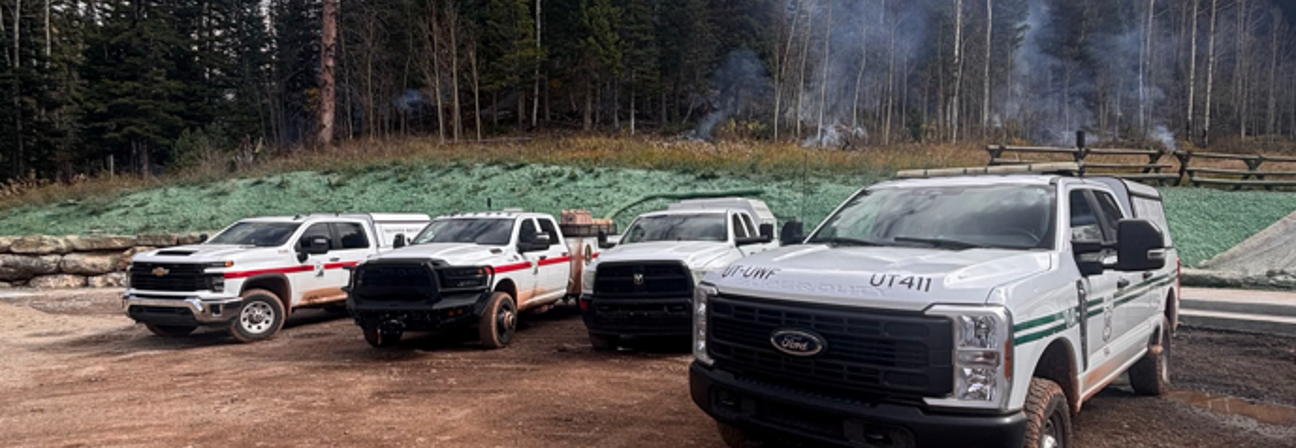
Thanks to two great partners, the US Forest Service and the Utah Division of Forestry, Fire and State Lands (FFSL), prescribed burns were completed on County open space at the top of Mill Creek Canyon Rd. These agencies are the experts in fire mitigation, and their willingness to partner and provide resources was the foundsation to this project. About 350 piles were burned across 180 of the County's roughly 400 acres in Upper Mill Creek Canyon.
This work matters to County residents. It lowers the risk of a large wildfire near neighborhoods, protects our trails and open spaces, and supports healthy habitat on public lands.
We are grateful to the Forest Service and FFSL for their teamwork on planning, coordination, and public notice. Clear communication was central to getting this project done.
The Bottom Line
Neither of these projects, and countless others that we work on, would look the same, or reach as far, if Salt Lake County Canyons Management had tried to do them alone. Every partner adds something, and together the work multiplies. We are grateful to the agencies and staff who make that possible, and we look forward to sharing more of what we accomplish together.